What was one concession the Federalists made to ensure the Constitution would be ratified?
Federalists and Antifederalists
While the Constitutional Convention was held to revise the Manufactures of Confederation, an entirely new constitution was drafted.
Learning Objectives
Explain the arguments made by the Federalists and Anti-Federalists over the new U.S. Constitution
Key Takeaways
Cardinal Points
- A Ramble Convention was called in the summer of 1787 to change the Articles of Confederation. During this time, many compromises were formed to appease regional factions.
- The Great Compromise brought together the New Jersey Plan and the Virginia Plan to create the Constitution 's legislative system. The 3-Fifths Compromise appeased Southern representatives by assuasive them to count slaves for representation and taxation purposes.
- The Federalists wanted a strong government and strong executive branch, while the anti-Federalists wanted a weaker central government.
- The Federalists did not want a bill of rights —they thought the new constitution was sufficient. The anti-federalists demanded a bill of rights.
Key Terms
- Articles of Confederation: The Articles of Confederation, formally the Articles of Confederation and Perpetual Union, was an agreement among the 13 founding states that established the United states of America every bit a confederation of sovereign states and served every bit its get-go constitution.
- delegate: A person authorized to human activity as representative for another; in politics, a political party representative allocated to nominate a political party candidate.
- Three-Fifths Compromise: an agreement between Southern and Northern states reached during the Philadelphia Convention of 1787, in which three-fifths of the population of freed slaves would be counted for representation purposes regarding both the distribution of taxes and the apportionment of the members of the Usa House of Representatives
The Constitutional Convention
In 1787, a convention was called in Philadelphia with the declared purpose of revising the Articles of Confederation. However, many delegates intended to utilize this convention to draft a new constitution. All states except for Rhode Island sent delegates, though not all delegates attended the Convention. At the Convention, the primary issue was representation of the states. Under the Articles, each country had i vote in Congress. The more than populous states wanted representation to exist based on population (proportional representation). James Madison of Virginia crafted the Virginia Plan, which guaranteed proportional representation and granted wide powers to the Congress. The smaller states, on the other mitt, supported equal representation through William Paterson'south New Bailiwick of jersey Plan. The New Jersey Plan also increased the Congress' power, but information technology did not go nearly as far as the Virginia Plan. The conflict threatened to end the Convention, but Roger Sherman of Connecticut proposed the "Slap-up Compromise" (or Connecticut Compromise) nether which one business firm of Congress would be based on proportional representation, and the other business firm would be based on equal representation. Somewhen, the Compromise was accepted, and the Convention was saved.
Compromises were important in settling other disputes at the Convention. The Iii-Fifths Compromise designated that iii-fifths of slave population would be counted toward representation in Congress. In another compromise, the Congress agreed to ban slave trade after 1808. Similarly, problems relating to the empowerment and election of the President were resolved. This led to the Electoral College system in choosing the Main Executive of the nation.
Federalists vs. Anti-federalists
The Constitution required ratification by ix states in order to come into effect. The fight for ratification was long and difficult. The Constitution was to be ratified by special ratifying conventions, non by land legislature. Interested in retaining power, states were resistant to ratifying a new, stronger central authorities. Those who favored ratification were known equally Federalists,while those who opposed it were considered Anti- Federalists.The Federalists attacked the weaknesses of the Manufactures of Confederation. On the other manus, the Anti-Federalists besides supported a House of Representative with substantive power. They acknowledged that the Constitution was not perfect, but they said that it was much ameliorate than any other proposal. Three Federalists—Alexander Hamilton, James Madison, and John Jay—wrote a series of essays called The Federalist Papers. These essays explained the Constitution and dedicated its provisions. The documents were intended for the state of New York, though people from across the country read them. The Federalists defended the weakest indicate of the Constitution—a lack of a Beak of Rights—past suggesting that current protections were sufficient and that the Congress could always propose Amendments. Anti-Federalists such as Patrick Henry attacked the Constitution, suggesting that it would lead to a dangerously powerful national government. 1 of the Anti-Federalist'southward strongest arguments was the Constitution's lack of a Bill of Rights. Many Anti-Federalists were eventually persuaded past the Federalists' arguments.
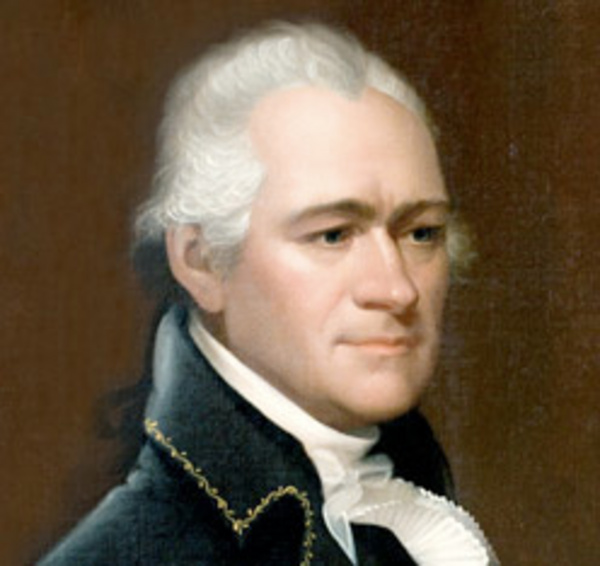
Alexander Hamilton: Alexander Hamilton was a fundamental player at the Ramble Convention.
The Federalist Papers
The Federalist Papers were written betwixt 1788-9 and encouraged people to ask their representatives to ratify the Constitution.
Learning Objectives
Identify the three authors of, the individual papers in, and the master reasons behind the Federalist Papers.
Fundamental Takeaways
Fundamental Points
- Federalist Paper No. x said that the Constitution had a check and balance organisation and so that no branch of government dominated the other.
- Federalist no. 51 said that a government like the U.S. naturally prevented factions from forming, thus protecting the peoples'–not the government's–interests.
- The Anti-Federalists had several complaints with the Constitution. One of their biggest was that the Constitution did non provide for a Beak of Rights protecting the people.
Fundamental Terms
- federalist: statesman or public effigy supporting the proposed Constitution of the United States between 1787 and 1789
- James Madison: James Madison, Jr. (March 16, 1751 (O.South. March 5) – June 28, 1836) was an American statesman and political theorist, the fourth President of the United States (1809–1817). He is hailed as the "Father of the Constitution" for being instrumental in the drafting of the The states Constitution and every bit the central champion and writer of the Usa Neb of Rights.
- Federalist Papers: The Federalist Papers are a series of 85 articles or essays promoting the ratification of the United States Constitution written by Alexander Hamilton, James Madison, and John Jay.
- Alexander Hamilton: Alexander Hamilton (January 11, 1755 or 1757[one] – July 12, 1804) was a Founding Father,[2] soldier, economist, and political philosopher, one of America'due south first constitutional lawyers and the first United States Secretary of the Treasury.
The Federalist Papers
During 1788 and 1789, in that location were 85 essays published in several New York State newspapers, designed to convince New York and Virginia voters to ratify the Constitution. The three people who are mostly best-selling for writing these essays are Alexander Hamilton, James Madison, and John Jay. Since Hamilton, Madison, and Jay were considered Federalists, this series of essays became known as The Federalist Papers. Ane of the most famous Federalist Papers is Federalist No. 10, which was written by Madison and argues that the checks and balances in the Constitution prevent the regime from falling victim to factions. Anti-Federalists did not support ratification. Madison as well wrote Federalist No. 51, nether the name "Publius" or "Public. " He argues here that each branch of government would not be dependent on other branches and, thus, forming factions within the national government. That manner, the government can work in the best interests of the people and not each other.

The Federalist Papers: Title page of the starting time press of the Federalist Papers.
Many individuals, such as Patrick Henry, George Mason, and Richard Henry Lee, were Anti-Federalists. The Anti-Federalists had several complaints with the Constitution. One of their biggest was that the Constitution did not provide for a Nib of Rights protecting the people. They also idea the Constitution gave too much power to the federal authorities and too trivial to individual states. A third complaint of the Anti-Federalists was that senators and the president were not directly elected by the people, and the Business firm of Representatives was elected every 2 years instead of annually. On December vii, 1787, Delaware was the kickoff state to ratify the Constitution. The vote was unanimous, 30-0. Pennsylvania followed on December 12, and New Bailiwick of jersey ratified on December 18, also in a unanimous vote. By summer 1788, Georgia, Connecticut, Massachusetts, Maryland, South Carolina, New Hampshire, Virginia, and New York had ratified the Constitution, and it went into issue. On August ii, 1788, Due north Carolina refused to ratify the Constitution without amendments, simply it relented and ratified information technology a twelvemonth after.
Ratification of the Constitution
In order for all states to ratify, a compromise over a pecker of rights had to exist made.
Learning Objectives
Discuss differences among united states of america on the question of ratifying the Constitution
Key Takeaways
Fundamental Points
- Beginning with Delaware, many states ratified the new constitution Between 1787 and 1788. Some ratified because they were promised a pecker of rights.
- All states except North Carolina ratified the new document and the Constitution went in effect by 1788. Northward Carolina demanded a bill of rights before ratifying information technology.
- On December fifteen, 1791, the Nib of Rights was added and listed natural liberties that the people had which could not be taken away by the federal government.
Cardinal Terms
- ratify: To give formal consent to; brand officially valid.
- Bill of Rights: The collective proper noun for the first ten amendments to the United states of america Constitution.
Ratification of the Constitution
Delaware was the first state to ratify the Constitution on December vii, 1787. The vote was unanimous, 30-0. Pennsylvania followed on December 12 and New Jersey ratified on December 18, also in a unanimous vote. The Constitution went into effect past the summertime of 1788 afterward the following states had ratified the Constitution: Georgia, Connecticut, Massachusetts, Maryland, Southward Carolina, New Hampshire, Virginia, and New York.
On August 2, 1788, Due north Carolina refused to ratify the Constitution without amendments, just relented and ratified it a year later. N Carolina was not the simply state that wanted amendments. New York and Virginia ratified the Constitution under the condition that a Bill of Rights be added. On September 26, 1789, Congress sent a list of twelve amendments to the states for ratification. Ten of the amendments would become the Pecker of Rights.

Congress of Confederation and the Constitution: The signing of the Constitution of the United states.
North Carolina ratified the Constitution in November of 1789, followed by Rhode Isle in May 1790. Vermont became the last land to ratify the Constitution on January 10, 1791.
The Bill of Rights
The Bill of Rights was enacted on Dec fifteen, 1791. Here is a summary of the ten amendments ratified on that day:
- Subpoena 1: Establishes freedom of organized religion, voice communication, the press, assembly, and petition.
- Subpoena 2: Establishes the right to keep and bear artillery.
- Amendment 3: Bans the forced quartering of soldiers.
- Amendment iv: Interdiction of unreasonable searches and seizures; a search warrant is required to search persons or belongings.
- Amendment five: Details the concepts of indictments, due process, self-incrimination, double jeopardy, and rules for eminent domain.
- Amendment half-dozen: Establishes rights to a off-white and speedy public trial, to a notice of accusations, to face up the accuser, to subpoenas, and to counsel.
- Amendment 7: Provides for the right to trial past jury in ceremonious cases.
- Amendment 8: Bans cruel and unusual punishment, and excessive fines or bail.
- Amendment 9: Lists unremunerated rights.
- Amendment 10: Limits the powers of the federal government to but those specifically granted past the constitution.
Source: https://courses.lumenlearning.com/boundless-politicalscience/chapter/ratification-of-the-constitution/
0 Response to "What was one concession the Federalists made to ensure the Constitution would be ratified?"
Postar um comentário